







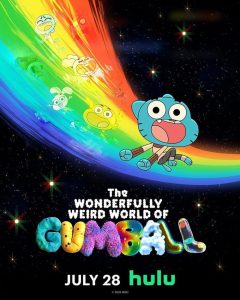
The Wonderfully Weird World of Gumball met my expectations almost exactly where they were. However, I must admit, I wanted a little more out of it.
In 2025, two seasons of a new sequel series to one of Cartoon Network’s most popular shows of the 2010s, The Amazing World of Gumball, were released on Hulu and Disney Plus. While this series serves as a great continuation of the format of the original show, modernized and a little refined, I was hoping that it would go beyond that format in meaningful, less episodic ways. The first season dropped with 20 episodes of very solid Gumball content. The jokes were funny and consistent with the style and tone of the original show, with some modern lingo and commentary. Gumball has always been a vessel for political commentary, and this show continues that.
When I watched season one, I enjoyed it, but I wanted it to address the cliffhanger ending of the original series. The Amazing World of Gumball ended with one of the antagonists, Rob, who had become a sort of hero unbeknownst to the main characters, falling into a void, symbolizing the cancellation of the show. This was a super meta moment from a show littered with them, and there was originally supposed to be a movie from Cartoon Network that would address this cliffhanger. But, with the studio behind it dropping out and no other studio wanting to make it, it was left in limbo for years.
After season one, I heard that the finale of season two would finally bring up the ending and the void, which had me very excited. I love the format of the show, but I also love when it follows a narrative, which it has been doing very loosely for years. The finale of season two ended up being a fun meta episode that did in fact push the lore forward for Rob’s character. But while it addressed the void, it did so in a way that pretty much kicked the can further down the road.
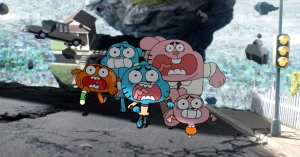
The void is a rift in the fabric of reality that opens up and swallows everything when a show is cancelled. What I wanted was to see a story in which the town of the show, Elmore, was crumbling due to the show being cancelled, and Gumball and his friends and family were forced to fix it. Instead, we got an episode where Rob has to stop the main characters from discovering the void, which would cause them to realize that they are in a TV show. This episode is an amazing episode that jokingly references some long-running plot holes in the show, like the impossible layout of Gumball’s house, but all it really does is advance Rob’s character and sets up the void as a problem in the future. It fails to be a very compelling follow-up to a cliffhanger that has lived rent-free in my head for the past seven years.
It’s not all disappointing, however. There were many things in these seasons that I loved. Firstly and most importantly, the animation is a huge step up from the previous series. It is clear that the animators had a lot of time and resources to improve the regular animations and experiment with many other forms of animation. For example, early in season one, there is an episode that largely takes place in a virtual reality. The visuals are a lot of fun, and it’s a rockin’ good time. Another thing that’s usually great is the comedy. It’s on par with the original series, which I’m glad for. It would’ve been a real shame if this show got sanitized just because it’s on Disney Plus now.
While some say that this show isn’t as good as the original show (which I don’t disagree with, although that may be the nostalgia speaking), I think it’s just as hit or miss as the original show. There are some good episodes and some bad ones. It’s good that this show really only has a few bad episodes, and its unique, complex, interesting qualities make it a stand out kids’show.